Bookish Posts, Uncategorized

What Stories Teach Us

Hello there, and welcome to another bookish post! I have a little under 100 pages left of Claire Fuller’s ‘Swimming Lessons’ left at the time of writing, and so I hope to have another book review for you soon. But for now, I wanted to take some time to write about a bookish reflection I had recently (yes, you can put ‘bookish’ in front of anything and if you think otherwise, you’re wrong).

So, what have I been reflecting on? Well, if you think back to the stories we all read as children, there is often some underlying theme – a lesson to learn – that forms the basis of each story. Those lessons could be about anything from caring for others, learning to share, or about believing in yourself and many of us (whether we realise it or not) carry those lessons with us.

But what about the stories we read as adults? We often think of them as merely being works of fiction, but even the stories we read as adults are crammed full of lessons to learn. They may be lessons about our purpose in life, understanding the daily struggles of others, or dealing with grief. These lessons may be much deeper in meaning than those in children’s books, but they are no less important.

So, why was I reflecting on this? Well, there are sometimes questions of why you would both reading fiction over non-fiction, why play make-believe when you could be learning about something ‘real’. I have always rejected this idea, but this reflection reminds me of the real-world implications of fiction. Fiction books are rarely entirely abstract from the real-world – Even fantasy novels will carry lessons that we can use in our day-to-day lives.

Not only is this form of learning entertaining, but many writers (from fiction writers to business management writers, and even many lifestyle/medical writers) are now recognising the powers of stories. After all, it’s not often that we truly connect with a fact or a statistic. Even the most shocking of statistics only stays with us momentarily before we continue with the world as normal. But the best of stories stay with us forever – I still remember how I felt when I read 1984, and I’m pretty sure that feeling will stay with me forever. And this is why they are probably the best method of teaching life lessons.

So, when you read your next book, try to pick out the different lessons the story teaches us, whether obvious or subtle. You may even want to consider how you can apply those lessons in your life – the choice is yours (just make sure you don’t take away from your enjoyment of the book). The moral of this reflection is, basically – Never underestimate the power of a good story.

This was a slightly different kind of post for you today, but it is always good to reflect once in a while, whether on global challenges or the more trivial aspects of life. If you would like to see more of these kinds of ‘reflections’, then please do let me know in the comments below, but for now, I’m off to grab myself a (decaf) coffee 🙂

TBT

Book Reviews

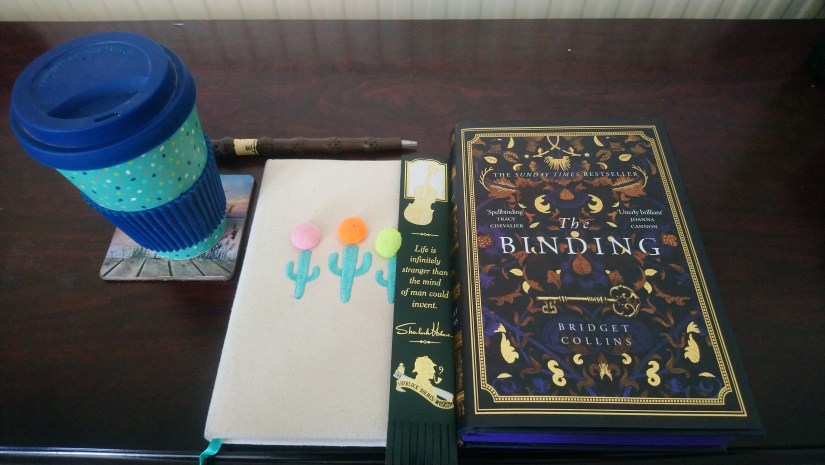
The Binding by Bridget Collins – Book Review

4 out of 5 Stars ✯✯✯✯

The Binding is Bridget Collins’ eighth published novel. The Binding, however, is Bridget Collins’ first adult fiction novel, with the other 7 novels falling within the young adult genre. This is the first of Bridget Collins’ novels I have read, and so I was interested to see what this novel would be like.

Before even opening this book, it makes an exciting impression on the eye and is probably one of the prettiest books I have come across – I felt myself unable to resist purchasing this book.

About the book
The beginning of the book takes a different approach to many others I have read. It starts with an unwell Emmett (the main character of the novel) working in the fields, when a letter arrives. In this letter, it is announced that Emmett has been specifically chosen by Seredith to be her apprentice.

This leaves Emmett’s Mother in shock, his Father enraged, and Emmett himself in a state of confusion. Seredith is a Binder, and Emmett’s parents had always warned Emmett against Binders and books. And yet Emmett’s Father has suddenly decided that it would do Emmett some good to work as Seredith’s apprentice and, eventually, Emmett’s Mother and Sister are in agreement too.

Emmett is therefore taken to Seredith who starts teaching Emmett about binding, and how to bind people. We learn that to bind a person, is to take certain memories away from them and store those memories in a book. So if you wish to forget about a traumatic event, a past relationship, or just something really embarrassing you once did many years ago, you can ask to be bound. Once bound, that memory will be stored (somewhat) safely in a book, and you will no longer remember whatever is now in the book.

At first, the art of Binding troubles Emmett – particularly the way a newly-bound person left blank-eyed, as though a part of them were missing. Seredith, however, remains resolute in her defence of Binding, showing Emmett the horrors that this person had gone through and how Binding is, actually, the lesser of two evils. Binders do not bind for the hell of it, but in fact they bind to make lives better for others. At least, this is the case when it comes to Seredith’s version of Binding.

But what happens when Binders wield their powers irresponsibly? Imagine what people could get away with if they were willing to pay Binders to make their victims forget what they have done to them. Seredith warns Emmett against this kind of Binding. Through no choice of his own, however, Emmett ends up with this type of Binder, and this is when we see the damage which unscrupulous Binders can cause.

My Rating – 4 Out of 5 Stars ✯✯✯✯
I used to love reading Fantasy novels – I found that there was little which provides as much pleasure to the imagination than a novel whose story seems so far from reality, and yet somehow realistic enough to be able to immerse oneself in the story. The Binding, however, is the first Fantasy novel I have read for years, and I feel that I chose a good book to re-join the world of Fantasy Fiction.

It took me some time to properly get into the book, but this is unsurprising given that Bridget Collins has had to create a whole new world in which Binders (and even books) are seen as an evil magic.

However, the way the story is built up from the start creates such a great sense of mystery and suspense which makes you want to keep reading and find out more. Why is Binding seen as an evil magic? What happens when this power is abused? How did Emmett get to this position, and why was he chosen? These are questions which we gradually get answers to as the book progresses.

Once I got past this point, I really started to enjoy this book. Bridget Collins created a wonderful story and characters I felt I could really connect with (or which I despised). I also enjoyed the questions of morality which arose – such as, is it right to have your memory erased to forget your bad memories? Do those bad memories actually form a part of who we are (which would explain the blank-eyed look of the person Emmett witnessed, shortly after they were bound)? These are the kind of questions I asked myself for a while after reading this book, which is a sign of the book leaving its own imprint on my brain.

Conclusion
It is the wonderful story, the characters that are easy to connect with, and the questions of morality you are left with to think over, that earn this novel the high score of 4 out of 5 stars. This was, therefore, a pleasurable return to the world of Fantasy fiction and I think I might come here more often.

Thank you for reading another of my book review. I hope you enjoyed, and I hope to have another book review soon.